Learning Outcomes:
i. Students will understand that the moment of a couple is independent of the reference point.
ii. Students will learn to apply the concept of torque and the principle of moments to prove this property.
iii. Students will appreciate the significance of this property in understanding the rotational effect of couples.
Introduction:
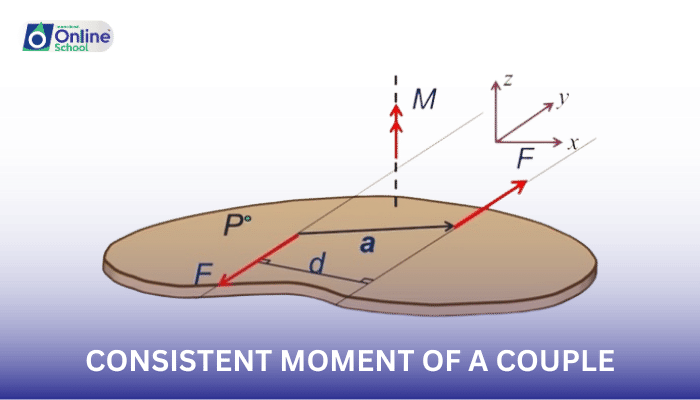
In the realm of physics, couples, also known as pairs of forces, play a crucial role in producing rotational motion. Couples are characterized by two equal and parallel forces acting on an object in opposite directions along different lines of action. A fundamental property of couples is that their moment, also known as torque, is independent of the reference point about which it is calculated. This lesson delves into the proof of this property, demonstrating that the turning effect of a couple remains constant regardless of the chosen reference point.
i. Moment of a Couple:
The moment of a couple, denoted by the symbol τ (tau), is a measure of the turning effect produced by the couple. It is calculated as the product of the force (F) and the perpendicular distance (d) between the lines of action of the forces.
τ = Fd
where τ is the moment of the couple, F is the magnitude of each force, and d is the perpendicular distance between the lines of action of the forces.
ii. Proof of the Consistent Moment:
To prove that the moment of a couple is independent of the reference point, consider a couple acting on an object. Let O and O' be two arbitrary reference points, and let d and d' be the perpendicular distances from each force to the respective reference points.
Using the principle of moments, we can write the moment of the couple about point O as:
τ = Fd
And the moment of the couple about point O' as:
τ = Fd'
Since the forces are equal and parallel, the ratio of d' to d is equal to the ratio of the perpendicular distances from the lines of action of the forces to the reference points.
d'/d = O'O/OO'
Substituting this into the second equation for τ, we get:
τ = F(d'/d)(OO')
Since the moment of the couple is a scalar quantity, it must be the same regardless of the reference point chosen. Therefore, we can equate the two expressions for τ:
Fd = F(d'/d)(OO')
Simplifying this equation, we obtain:
1 = d'/d
This implies that the ratio of d' to d is always equal to 1, confirming that the moment of the couple is independent of the reference point.
iii. Significance of the Consistent Moment:
The consistent moment of a couple is a crucial property that simplifies the analysis of rotational motion produced by couples. It allows us to calculate the torque produced by a couple without considering the specific reference point, making the calculations more straightforward and less dependent on arbitrary choices.
Couples, with their consistent moment, play a fundamental role in rotational motion, providing a mechanism for producing rotation without causing any translational motion. Understanding the property of the consistent moment is essential for comprehending the rotational effect of couples and applying them in various physical and mechanical scenarios. By grasping this property, students gain a deeper appreciation of the forces that govern the rotational behavior of objects in our world.
